Chip Stocks Tumble After CPI: AMD Drops 5.70%, Intel Falls Below $100 and the Nasdaq-100 Loses 2.02%
Hotter-than-expected U.S. inflation and doubts about AI financing sank semiconductor stocks on October 14: AMD -5.70%, Intel -4.61% to $97.74 and Nvidia -3.07%. The Nasdaq-100 fell 2.02% and the S&P 500 1.11%.
A Rough Day for Semiconductors: CPI and AI Worries Hit AMD, Intel and Nvidia
The U.S. inflation report on Tuesday, October 14, set off the Nasdaq's worst session since July. According to Stock Tracker's market dashboard, the Nasdaq-100 fell 2.02% (-618.68 points) to 29,950.82, slipping below 30,000, and the S&P 500 lost 1.11% (-86.51 points) to 7,718.94. Semiconductors led the decline: AMD dropped 5.70%, Intel fell 4.61%, losing the $100 mark, and Nvidia slid 3.07%.
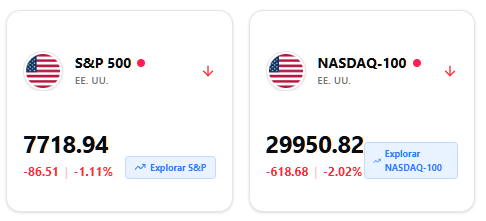
S&P 500 and Nasdaq-100 closing levels on October 14, on Stock Tracker's market dashboard.
The Hardest-Hit Stocks
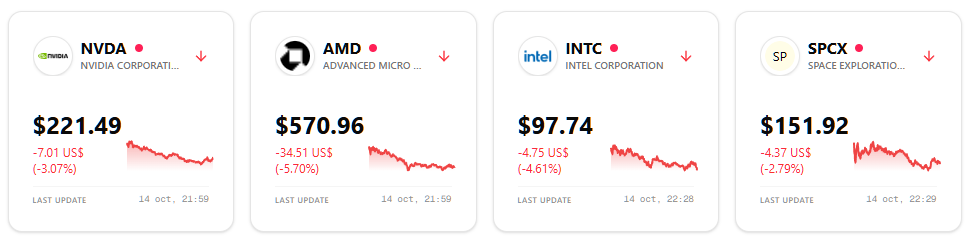
Nvidia, AMD, Intel and SpaceX quotes on October 14, on Stock Tracker's dashboard.
| Stock | Price | Change | Change (%) |
|---|---|---|---|
| AMD | $570.96 | -$34.51 | -5.70% |
| Intel (INTC) | $97.74 | -$4.75 | -4.61% |
| Nvidia (NVDA) | $221.49 | -$7.01 | -3.07% |
| SpaceX (SPCX) | $151.92 | -$4.37 | -2.79% |
AMD: the Biggest Drop, After a Gain of More Than 180% This Year
AMD was the worst performer of the group, down $34.51 to $570.96. According to MarketBeat, the stock is up about 183% year to date, and such a rich valuation makes it more vulnerable to profit-taking when sentiment turns. Ironically, the drop came on the same day Bank of America raised its price target to $720, citing the potential of its server processors for AI workloads.
Intel Falls Below $100
Intel fell 4.61% to $97.74, breaking below the psychological $100 level. The drop adds to the October 8 sell-off, when it closed at $107.08 after the Financial Times report on OpenAI's revenue: in just one week, the stock has lost about 9%.
Nvidia and SpaceX
Nvidia slid 3.07% to $221.49, also below its October 8 close of $230.48. SpaceX (SPCX), which has traded on the Nasdaq since its June 12 IPO at $135 a share, fell 2.79% to $151.92, dragged down by the weak Nasdaq, though it is still more than 12% above its IPO price.
What's Behind the Drop
1. Hotter-Than-Expected Inflation
September CPI rose to 3.7% year over year, above the 3.6% forecast, and core inflation surprised to the upside at 2.6%. The data lifted the odds of another Fed rate hike in October to about 54%, according to CME FedWatch. Bond yields reacted sharply: according to Benzinga, the 2-year Treasury yield rose 13 basis points to 4.93% and the 10-year rose 9 basis points to 5.31%.
Higher rates hit growth-oriented tech stocks hardest: much of their value depends on earnings expected years down the road, and the higher the rate used to discount them, the lower their value today.
2. Doubts About AI Financing
According to Barron's, a sell-off in CoreWeave's bonds revived doubts about how AI infrastructure is being financed, and the press also pointed to pressure on other data-center names such as Oracle. It was the sector's second shock in a week, following the October 8 report on OpenAI's revenue.
3. Supply-Chain Signals
ASML warned it won't be able to fully meet demand over the next two years despite record third-quarter sales, and some reports pointed to Chinese competition in memory after progress by CXMT. Other chipmakers fell too: Micron about 4% and Broadcom about 3.1%.
A Sector on a Losing Streak
The Philadelphia Semiconductor Index (SOX) dropped 4.30%, its sixth straight losing session. The Nasdaq Composite fell 1.88% to 26,692.87, its biggest one-day drop since July.
Sources: Stock Tracker's market dashboard for S&P 500, Nasdaq-100, AMD, Intel, Nvidia and SpaceX quotes (screenshots from October 14, between 21:59 and 22:29 Spanish time); BBN Times, CNN, Investing.com and Yahoo Finance for the Nasdaq Composite, the SOX index and sector moves; MarketBeat, Benzinga, Gotrade (citing Barron's) and FX Leaders for AMD; CNBC for CPI and CME FedWatch; Financer and Keeptrack for the SpaceX IPO. Some press sources report slightly different closing prices (for example, $570.82 for AMD); this article uses Stock Tracker's dashboard data. No Alpha Vantage data was used.
Levels to Watch
- Nasdaq-100 at 30,000: reclaiming that level would be the first sign of stabilization after losing it in this session
- Intel at $100: getting back above this psychological level, or settling below it, will set the tone for the coming sessions
- AMD vs. Bank of America's $720 target: the gap between the share price and analyst targets suggests the drop reflects sentiment more than a change in the outlook
- The SOX index: breaking the six-session losing streak would be key for the sector
- The Fed's October 27-28 meeting: with hike odds around 54%, every data point and every Fed comment can move tech stocks
What It Means for Investors
The October 14 session shows how two forces can line up and amplify each other: a macro factor, rising inflation and rates, and a sector-specific one, doubts about whether AI spending can be financed and pay off on schedule. The stocks that have rallied the most, like AMD, tend to be the most exposed to profit-taking when sentiment shifts.
At the same time, in AMD's case the drop wasn't driven by any company-specific news: it is coming off results with 50.1% revenue growth and got a price-target increase that same day. That's why the path of interest rates over the coming weeks will be key to telling whether this is a passing correction or a change in trend.
Conclusion
Hotter-than-expected inflation and doubts about AI financing combined on October 14 to trigger a sharp sell-off in semiconductors. AMD dropped 5.70% to $570.96, Intel fell below $100 with a 4.61% loss, and Nvidia slid 3.07%, while the Nasdaq-100 fell 2.02% and lost the 30,000 mark. With the chip index on a six-session losing streak and the Fed two weeks away from an open decision, the sector faces a volatile stretch in which interest rates will matter as much as AI headlines.